
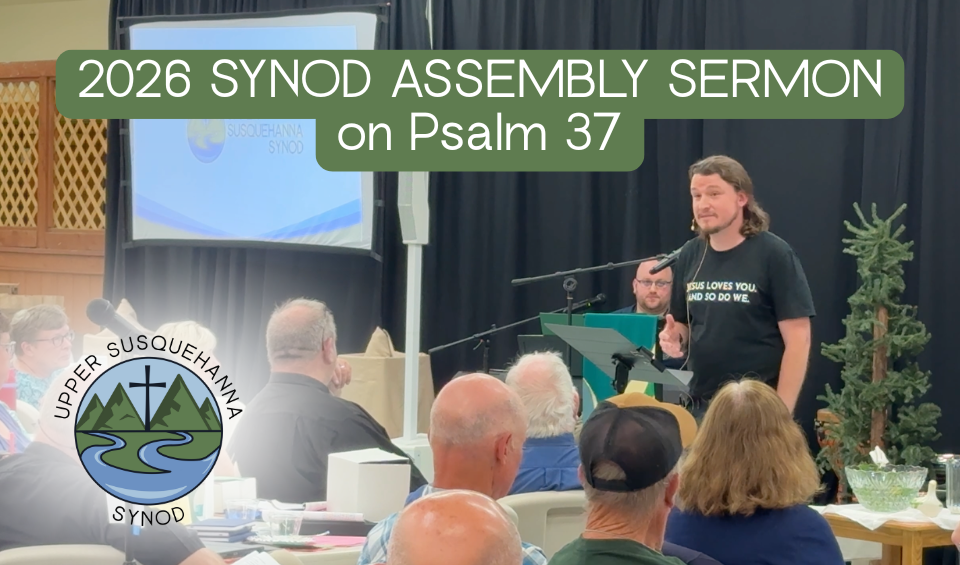
2026 USS Synod Assembly
SERMON on PSALM 37
Rev. Jim Vitale
This sermon was delivered at the 39th Upper Susquehanna Synod Assembly on Saturday, June 6, 2026 during the service of Holy Communion. The featured text is Psalm 37, from the NRSVue translation.
I.
We are troubled by two tricky twins.
So says the author of Psalm 37. In this poem, the psalmist warns against the twin vices of charah and qanna, anger and envy. They are, really, two sides of the same coin: both show our obsession with other people and both reveal our need for another way.
II.
The first vice, charah, is translated in the NRSV as “fret”, but in Hebrew the word literally means to kindle or burn. This is not just momentary anxiety but a kindled, burning anger. To be filled with charah, is to obsess over what you hate about another person.
Nowhere is our charah better on display than in the media. For years, media moguls have known that nothing makes money like outrage. Whip people up into a frenzy and they will always come back for more. Whether it’s the dishonest spin of the 24-hour news cycle or the toxic vitriol of the Facebook feed, we are constantly dumping fuel on the fire of our anger, kindling outrage against anyone and everyone. This sort of anger actively erodes our humility, encouraging us instead to blame other people for the world’s problems.
We in the church are pretty good at this. “The church is in decline,” we tell ourselves. And who is to blame? Young people, because they don’t come to church anymore! Christian nationalists, because they’ve filled the church with hate! DEI, because it’s driven a wedge between everyone! The problem is always with someone else and never ourselves. That is charah.
III.
The second vice, qanna, is translated as “envy,” but in Hebrew it means to be zealously jealous. This is not a passing whim of covetousness: this is being consumed with envy. To be filled with qanna, is to obsess over what you love about another person. But don’t be misled—qanna is not love at all.
Just like chara, qanna thrives on the internet. Between near-constant advertisements and influencers putting their seemingly-perfect lives on full display, there is no shortage of fuel for our envy. I have found that my phone can be a powerful tool for sewing discontentment. As I scroll, I begin to want what other people have, to go where they go, to be who they are. I become ashamed of myself. Feeling inadequate, I objectify other people and covet after them.
We in the church are pretty good at this one, too, aren’t we? How often I drive by the non-denominational church with its packed parking lot and think, “Oh if only our churches could have so many people!” Or I hear about bigger summer camps and think, “Man, if only I could have their budget and staff!” Or we look at the church down the road that has a full-time pastor and think, “why do they get a pastor and we don’t?” Or we hear about some innovative program and think “If only my congregation or my pastor would do that!” Or, perhaps worst of all, we covet what we once were: the church boom of the 1950s. Nostalgia is just another form of envy, except instead of envying other people, we envy our past selves. That is qanna.
IV.
Our kindled anger and zealous jealousy are consuming the church. They alienate us from our neighbors, each other, ourselves, and our God. They bring us further away from the kingdom of heaven, not closer to it. But the reality is that everything we hate about other people, everything we covet about other people, all of it will soon be gone, the Psalmist reminds us: “[The works of anger and envy] will soon fade like the grass and wither like the green herb…[they] are like the glory of the pastures…like smoke they vanish away” (37:2, 20).
God does not want us to live our lives in anger and envy. The Psalmist writes, “refrain from anger, and…do not fret—it leads only to evil.” (37:8) We need a cure for these twin troubles of charah and qanna, anger and envy. Thankfully, in verse 34, the Psalmist provides us with the antidote. They write: qeveh el yahvah. Wait for the Lord (37:34).
The word that we translate as “wait” is not just some idle thumb-twiddling. It is perhaps best translated as “look eagerly for the Lord” or simply, “hope for the Lord.” To put it another way, our strength for today and bright hope for tomorrow lies not in people and things but in God alone. God alone is our strength for today. God alone is our bright hope for tomorrow. Nothing, not increased church attendance, not a bigger budget, not a flashier logo, not a neon sign, not the most contemporary worship, not the fanciest curated liturgy, not the most youth, not the greatest diversity, not the coolest program, not “the way we’ve always done it,” none of it can save us. God alone can do that. We are called to qeveh el yahvah: put all our hope and trust in the Lord our God.
Ours is a time of uncertainty. I know it’s hard to hear it, but what the church used to be is passing away, my friends, and what it will be has not yet been revealed. It makes sense that we would all be anxious about the state of our congregations, about the state of our synod, about the state of the church. So often we to respond this uncertainty with the twin troubles of charah and qanna, anger and envy. But God calls us instead to respond with hope, trusting not in ourselves and what we might do, but in God and what God is doing.
V.
To wait for the Lord is to put our hope in God, but that does not mean that we remain passive. Quite the opposite—especially in this age of instant gratification, waiting is hard work!
Verse 7 reads, “Be still before the Lord and wait patiently for him.” (37:7) Waiting for the Lord requires quiet. We have to listen closely and pay attention. But we cannot do that if our ears are filled with the noise of anger and envy. First, we have to stop worrying about what other people are doing. God is not calling you to be someone else—God is calling you to be you. God is not calling your church to be some other church—God is calling your church to be your church. God does not want Zion Lutheran Church to become another Beaver Lutheran Church. God wants Zion to be Zion and Beaver to be Beaver. But we will have no idea who we are called to be if we don’t stop lusting after who other people are.
Once we stop worrying what other people are doing, then we can focus on what God is doing. We do this through careful discernment and by asking a lot of questions. We wonder, “What is God up to in my life?” and we take stock of our responsibilities and passions. We wonder, “What is God up to in my congregation?” and we look honestly at our past and present to see the trends. We wonder, “What is God up to in my neighborhood?” and we go talk to our neighbors and listen to their stories. We wonder, “What is God up to in the world?” and we engage in current events (rather than avoiding them as “too political”). In short, we become investigators. We become like journalists, out in the field, gathering information, becoming experts, preparing to tell the story of what God is doing.
Notice that none of this comes from anger or envy and none of this requires us to fix, solve, or change anything. What we are is passing away; what we will become has not yet been revealed. We cannot speed up this process. Dying takes time. Resurrection takes time. The only faithful thing to do is wait. Turn from charah and qanna. Qeveh el yahvah. Let go of your anger and envy. Look eagerly for the Lord!
The future of the church is in God’s hands, my friends, not ours. So let us look eagerly to what God is doing. Because God is our strength for today, and God is our bright hope for tomorrow.
Amen.